Quadratic formula

A quadratic function with roots x = 1 and x = 4.
In algebra, the quadratic formula is the solution of the quadratic equation. There are other ways to solve the quadratic equation instead of using the quadratic formula, such as factoring, completing the square, or graphing. Using the quadratic formula is often the most convenient way.
The general quadratic equation is

Here x represents an unknown, while a, b, and c are constants with a not equal to 0. One can verify that the quadratic formula satisfies the quadratic equation by inserting the former into the latter. With the above parameterization, the quadratic formula is:
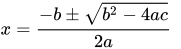
Each of the solutions given by the quadratic formula is called a root of the quadratic equation. Geometrically, these roots represent the x values at which any parabola, explicitly given as y = ax2 + bx + c, crosses the x-axis. As well as being a formula that will yield the zeros of any parabola, the quadratic formula will give the axis of symmetry of the parabola, and it can be used to immediately determine how many real zeros the quadratic equation has.
Derivations of the formula
By using the 'completing the square' method
The quadratic formula can be derived with a simple application of technique of completing the square
The derivations are as follows:
The derivations are as follows:
Derivation
Divide the quadratic equation by a, which is allowed because a is non-zero:

Subtract ca from both sides of the equation, yielding:
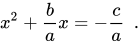
The quadratic equation is now in a form to which the method of completing the square can be applied. Thus, add a constant to both sides of the equation such that the left hand side becomes a complete square.

which produces:
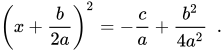
Accordingly, after rearranging the terms on the right hand side to have a common denominator, we obtain:
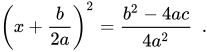
The square has thus been completed. Taking the square root of both sides yields the following equation:
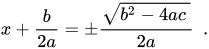
Isolating x gives the quadratic formula:
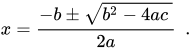
The plus-minus symbol indicates that


